Cooktops, Range Hoods and Make-Up Air in Airtight Homes
By Brett Sichello · Originally published , updated
The main difference between an induction cooktop and a gas cooktop in a modern airtight home comes down to the indoor air pollutants each creates and the complexity of the make-up-air system required to keep the air pressure inside the home in balance. In the early days of Passive Houses in North America, the recommended approach was a recirculating range hood paired with an ERV/HRV exhaust in the kitchen. Over the years we've learned a lot, so in this article we'll dive deep into why we no longer recommend that approach, and why we firmly stand by recommending an electric induction cooktop, a right-sized range hood and a dedicated make-up-air system for most homes we design.
Gas Cooktops
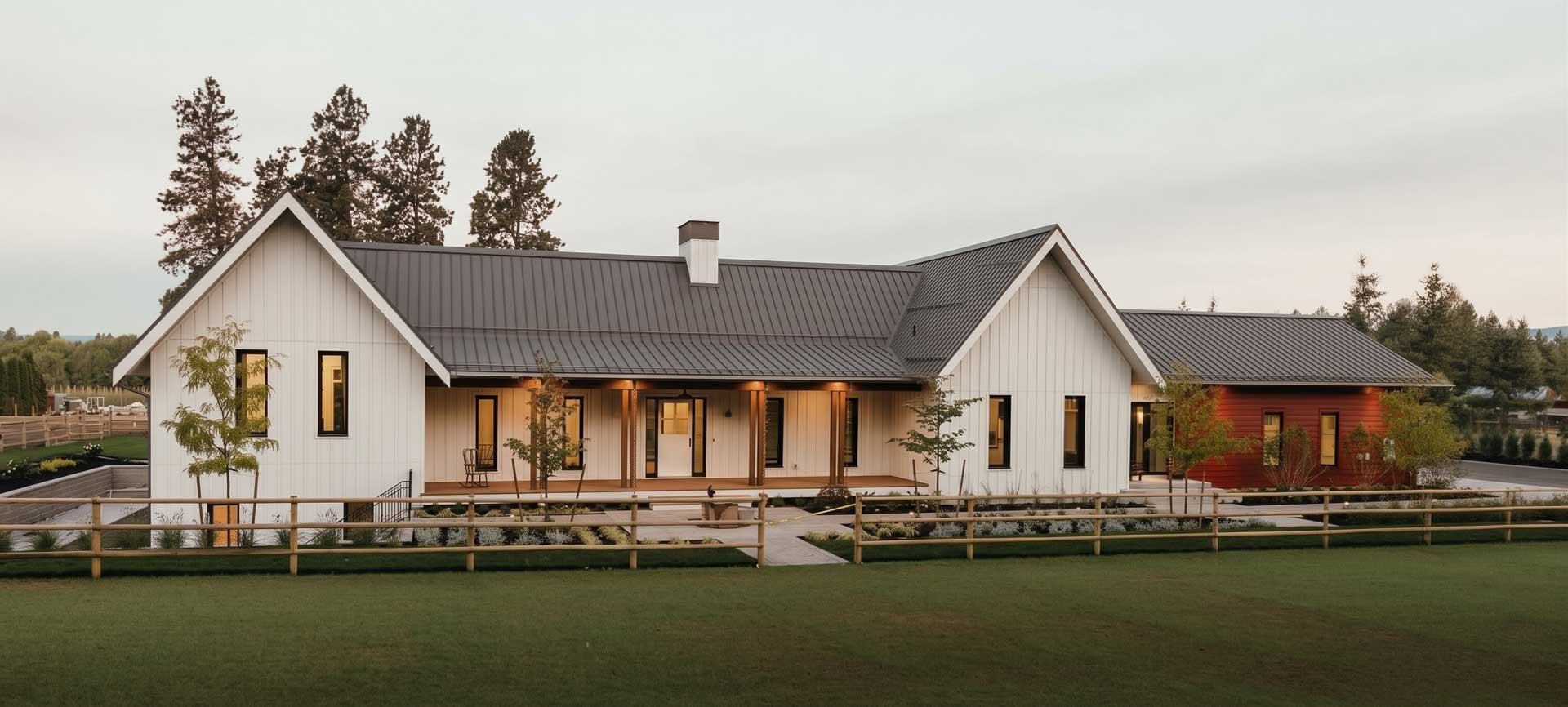
There is something undeniable about cooking on an open flame. This article is not going to suggest you can't put a gas cooktop in a modern airtight home. If you want gas, that is your choice, and it's our job to make it happen. However, the intent of this article is to give you several reasons why we don't recommend gas cooktops in modern airtight homes if you are concerned about indoor air quality, range hood fan noise and installation costs.
Indoor Air Quality
Natural gas is a mix of hydrocarbons which, in the combustion process, convert into particulate matter and indoor air pollutants including carbon monoxide, nitrogen dioxide, carbon dioxide, acetaldehyde and formaldehyde [2]. These pollutants must be exhausted directly to the outside by a range hood.
The main problem is that range hoods are selected by homeowners mostly based on aesthetics, without considering if the hood design can effectively capture pollutants, especially from the front burners, or consider the impact the fan flow rating (CFM - cubic feet of air exhausted per minute) has on noise inside the room, as well as the energy lost throughout the entire home. When you pay to heat the air in your home, your range hood is one of the quickest ways to suck all of that energy out of the home.
Range Hood Noise
Range hoods are often selected based on "rules of thumb" suggested by an appliance store salesperson rather than a proper calculation of the correctly sized hood. This "rule of thumb" approach results in loud, oversized fans and ironically, the excessive noise problem compounds back into an indoor air quality problem. Research by Lawrence Berkeley National Laboratory and other indoor air quality researchers shows that residential range hoods are used during only 10-35% of cooking events [1, 10]. In the case of gas cooktops, studies show that people don't think the pollutants being created are harmful so they don't bother turning the fan on and others don't turn them on because of how loud they are [8, 9]. The result: poor indoor air quality. Think of it like the tailpipe of your car exhausting inside your home, a fan helps but only if it is turned on.
Electric Induction Cooktops
An electric induction cooktop fundamentally changes the physics by cutting the required exhaust airflow by roughly 40-50% [7, 13, 14]. The physics change because a gas cooktop delivers only about a third of its energy to the pot and rejects the rest into the room as heat, along with combustion pollutants and water vapour, whereas induction transfers roughly 85% of its energy directly into the cookware, without combustion pollutants or excessive moisture [12].
Choosing an induction cooktop greatly reduces the impact on indoor air quality and because the CFM rating of the range hood can be much lower it is not as noisy making it that much more likely that the occupants will turn it on when cooking.
Admittedly, predicting occupant behaviour is tricky business. You can never guarantee that an occupant will turn on a range hood but the fact that the indoor air pollutants are significantly decreased is what matters most. Where we can account for occupant behaviour is by including a dedicated ERV/HRV extract near the kitchen that constantly exhausts 24/7/365 regardless of whether the occupant turns on the range hood or not.
Make-Up Air
With either a gas cooktop or an electric induction cooktop, we recommend a make-up-air system. A make-up-air system offsets the air exhausted by the range hood by bringing fresh outdoor air into the home, keeping the air pressure inside the home in balance.
Without make-up air, a range hood depressurizes an airtight home and the hood captures fewer pollutants. In winter months, cold outdoor air is pulled in through every small leak in the building envelope, causing drafts in cold climates (Zones 4-8). A depressurized house can also backdraft a fireplace or wood stove, and draw in soil gases such as radon and, in fire season, wildfire smoke. Air moving through the envelope can also carry moisture into wall, floor and roof assemblies where water, wood and insulation don't mix: over the long term the result can be hidden rot and mould, especially where assemblies have no drying potential designed into them.
The main difference between the two approaches lies in how the make-up-air system must be designed.
A gas cooktop needs a very active make-up-air system which includes many pieces of equipment because of the high-CFM range hood and the combustion pollutants it must remove. These units are expensive, often as expensive as entire ERVs/HRVs. They are operated by an electrical current sensor detecting the range hood running, a motorized tight-seal damper opens and filtered outdoor air flows in. Due to the high CFM range hood, a variable speed inline fan (which generates noise) must match the speed of air coming into the home to the rate at which the range hood is exhausting the air. Then because so much more has to be exhausted with a gas cooktop, the cold air coming in needs to be heated with a modulating 5-8 kW electric duct heater. And finally, because the system includes a loud fan pumping hundreds of CFM into the house the air should be passed through a duct silencer to reduce the noise entering the home.
With an induction cooktop, the make-up-air system is mostly passive: when the electrical current sensor detects the range hood running, a motorized tight-seal damper opens and filtered outdoor air flows in to replace the exhausted air, with no booster fan or electric duct heater needed.
Make-Up-Air System Components
| Component | Gas Cooktop | Electric Induction Cooktop |
|---|---|---|
| Range hood current sensor | Required | Required |
| Motorized tight-seal damper | Required | Required |
| Inline air filter box | Required | Required |
| Variable-speed inline booster fan | Required | Not needed |
| Duct silencer | Required | Not needed |
| Option A: dedicated ERV/HRV ventilation with a modulating electric duct heater* | Required* | Not needed |
| Option B: ducted heating system return air* | Required* | Not needed but can be incorporated* |
| Dedicated 30/40A 240V circuit for the duct heater (Option A) | Required | Not needed |
*Depending on how the heating, cooling and ventilation systems are designed, either option can be used. We always recommend a dedicated, balanced ERV/HRV duct system, but occasionally, for cost savings, we combine the heating/cooling system with the ERV/HRV ventilation system. In that case, dedicated ventilation exhaust ducts are routed to the bathrooms, one main fresh-air supply is routed into the return air of the heating/cooling system, and the range hood make-up-air duct is also routed into the return air trunk which utilizes the main heating system to temper (heat) the make-up air.
Lessons Learned
I want to be clear about why I've arrived at recommending induction cooktops paired with a right-sized range hood and a passive make-up-air system. They say the best way to learn is from your own mistakes, and this one comes from a Passive House we designed in Kelowna, BC in 2020.
Our clients requested a gas cooktop, so we included a dedicated make-up-air system that worked as intended, exhausting pollutants while maintaining the indoor air quality, thermal comfort and pressure balance of the house. Where the system went wrong was the acoustics, we intentionally located the unit in a conditioned mechanical room in the attached garage which was acoustically separated from the thermal envelope of the home. The space was small and the contractor introduced excessive duct bends which increased airflow velocity leading to even more noise being transferred into the home. Where the design and installation could have been improved was to include a duct silencer and minimize the duct bends. Even then, I question how much noise would be transferred into the living space of the home. Looking back, if you consider how loud a 300-400 CFM range hood is, then double that noise with a second make-up-air fan running at 300-400 CFM that is a lot of noise being generated. The interior of a Passive House is incredibly quiet. You notice every little noise you would never hear in a conventionally built house, so when you introduce two fans running at 300-400 CFM into a space that acoustically behaves like a recording studio, it is very obtrusive impacting occupant comfort.
One more example: in 2025 I built my own almost-Passive House. We included an induction cooktop, a ducted range hood with 6" insulated hard-pipe ducting, and a dedicated ERV extract near the kitchen. We typically run the range hood only on low speed (about 150 CFM), below the BC Building Code's make-up-air threshold for our airtight house (0.8 ACH @ 50 Pa). My thinking was that rather than installing the interlocked motorized damper for make-up air, we would just crack a window or a door when the range hood was on. I crack the window every time, but my mistake was thinking I could predict how everyone in the house would behave. I should have known better. The system does work but to be honest I should have installed the motorized damper for make-up air during construction to cover the times we forget to crack a window or a door. Thankfully, I included rough-ins for the motorized damper during construction, so it is just a matter of installing the unit.
Passive House: Recirculating Hoods and ERV/HRV Kitchen Extracts
After designing and consulting on numerous Passive Houses and high-performance homes over the years, the question we kept coming back to is what matters more: satisfying numbers in an energy model spreadsheet, or occupant health? Passive House is ultimately about energy, comfort and occupant health. Over the last 15 years I have consistently read research showing that recirculating range hoods do not effectively capture the pollutants from cooking even a single egg on an induction cooktop [8, 11], and the reasons are simple. It comes down to two things: the charcoal filter in the range hood, and the low ventilation rate of the ERV/HRV kitchen extract.
Charcoal filters in recirculating range hoods capture grease and odours to a point, but they do not remove water vapour (think of how often we boil water for noodles or rice, or simmer a sauce). The charcoal filters in recirculating range hoods are thin and saturate within weeks [11], and the more you learn about indoor air quality, the clearer it becomes that thin charcoal filters are largely ineffective when paired with a high-CFM fan (150 CFM or more). For charcoal filters to be effective, they need a thick bed of charcoal with slow-moving air, to maximize the time pollutants stay in contact with the activated charcoal. Even changing the filters every six months is a losing battle, which you can verify with inexpensive indoor air quality monitors that measure VOCs (volatile organic compounds) and PM2.5 (fine particulate matter).
An ERV/HRV extract in the kitchen is still a good idea, as it helps exhaust steam and other airborne pollutants, but it does so slowly. In the PHPP (Passive House Planning Package), the minimum flow rate of the kitchen extract is typically designed at about 35 CFM (60 m³/h). As taught in Passive House training, it is placed no closer than 6'-0" from the cooktop, and ideally it has a grease filter to keep airborne grease out of the ventilation ductwork and the ERV/HRV heat exchange core. A standard bathroom exhaust fan is often around 100 CFM. Now think of cooking a greasy hamburger or steak, boiling water for noodles and simmering a sauce on the side, and ask how effective 35 CFM really is, even running continuously. And the real airflow is likely less than 35 CFM, because the extract's grease filter clogs, reducing airflow, and needs changing every six months or more often, depending on how you cook.
I don't think the Passive House Institute was wrong to suggest this approach originally, and Passive House guidance has since evolved. As discussed earlier, occupant behaviour research shows that people turn on their range hoods for only 10-35% of cooking events [1, 10], mainly because of noise, and because combustion gases are invisible [9]. A dedicated ERV/HRV extract in the kitchen running 24/7/365 is much better than a range hood that is never turned on.
If I have learned anything over the years it is that every project needs to be evaluated on its own. I am clearly recommending a solution for modern airtight homes but I would evaluate the solution for a multifamily residential building differently because that is a significantly different set of parameters to take into account. What I do know is that "rules of thumb" simply don't work in the long term and it is why I put such emphasis on the durability of the Passive House approach to buildings. It's studied, measured, and verified over decades now and it is why I continue to believe that if we are to make better buildings they must be rooted in Passive House principles combined with low embodied energy materials.
What Makes a Range Hood Effective
The following parameters define a well-designed range hood for maximum pollutant capture:
- Sides: 3" minimum overhang past the edges of the cooktop below.
- Depth: 22" minimum to collect pollutants from the front burners.
- Height: 24-30"* from the cooktop to the bottom of the hood - the greater the distance the more pollutants escape and fan size has to be increased. *Set by the manufacturer's installation instructions and local code.
- Hood walls: 1" minimum vertical side walls before the stainless steel baffles - the recess allows pollutants to collect while the fan exhausts them, instead of spilling out the sides.
- Location: a wall-mounted range hood captures pollutants much more effectively than an island range hood, which is exposed to cross drafts on all sides and needs 30-50% more airflow [8, 14].
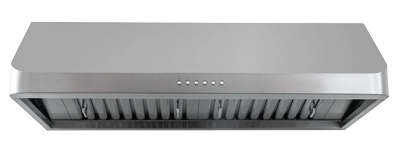
To be clear, a well-designed range hood and an aesthetically pleasing one are two different things. In many modern kitchens, from a designer's perspective, I never want to see the range hood, so we tend to specify undermount range hoods. Admittedly, they don't capture pollutants as well, but paired with an induction cooktop the pollutants are much lower, so it isn't as big a concern as it is with a gas cooktop. Just one more reason to ditch the flame, step into the future, and breath that fresh air.
Summary
If you are designing a high-performance home, we recommend an induction cooktop paired with an appropriately sized range hood and a passive make-up-air system, because of its lower cost and fewer indoor air pollutants. We understand that everyone has a preferred way to cook. Our job is to explain the advantages and disadvantages of each approach and to design the system correctly for the choice you make.
For more on ventilation and heat loss, see Six Enemies of Heat Loss in Homes, or the FAQ.
References
- Energy Impacts of Effective Range Hood Use for all U.S. Residential Cooking. Jennifer M. Logue and Brett C. Singer. Environmental Energy Technologies Division, June 2014.
- Ultrafine particles and nitrogen oxides generated by gas and electric cooking. M. Dennekamp, S. Howarth, C. Dick, J. Cherrie, K. Donaldson and A. Seaton. 2001.
- BSI-070: First Deal with the Manure and Then Don't Suck. Joseph Lstiburek. 2014.
- The most screwed up, badly designed, inappropriately used appliance in your home: the kitchen exhaust. Lloyd Alter. 2013.
- Uncut and Hoodwinked: The unintended consequences of monster-size range hoods. Robert Bean. 2013.
- How to Provide Makeup Air for Range Hoods. Martin Holladay, GreenBuildingAdvisor.com, 2015.
- Performance Assessment of U.S. Residential Cooking Exhaust Hoods. W.W. Delp and B.C. Singer. Environmental Science & Technology, 46(11), 6167-6173, 2012.
- Performance of Installed Cooking Exhaust Devices. B.C. Singer, W.W. Delp, M.G. Apte and P.N. Price. Indoor Air, 22(3), 224-234, 2012 (LBNL-5265E).
- Cooking Appliance Use in California Homes: Data Collected from a Web-Based Survey. V.L. Klug, A.B. Lobscheid and B.C. Singer. Lawrence Berkeley National Laboratory, LBNL-5028E, 2011.
- Factors Impacting Range Hood Use in California Houses and Low-Income Apartments. H. Zhao, W.R. Chan, W.W. Delp, H. Tang, I.S. Walker and B.C. Singer. International Journal of Environmental Research and Public Health, 17(23), 8870, 2020.
- Efficiency of recirculation hoods with regard to PM2.5 and NO2. P. Jacobs and H.J.M. Cornelissen. Proceedings of Healthy Buildings 2017 Europe (TNO, Netherlands), 2017.
- ENERGY STAR Emerging Technology Award: Residential Induction Cooking Tops (citing Frontier Energy testing). U.S. Environmental Protection Agency and U.S. Department of Energy, 2021-2022.
- ASHRAE Standard 62.2: Ventilation and Acceptable Indoor Air Quality in Residential Buildings. ASHRAE.
- Range hood sizing guidelines. Home Ventilating Institute (HVI).